
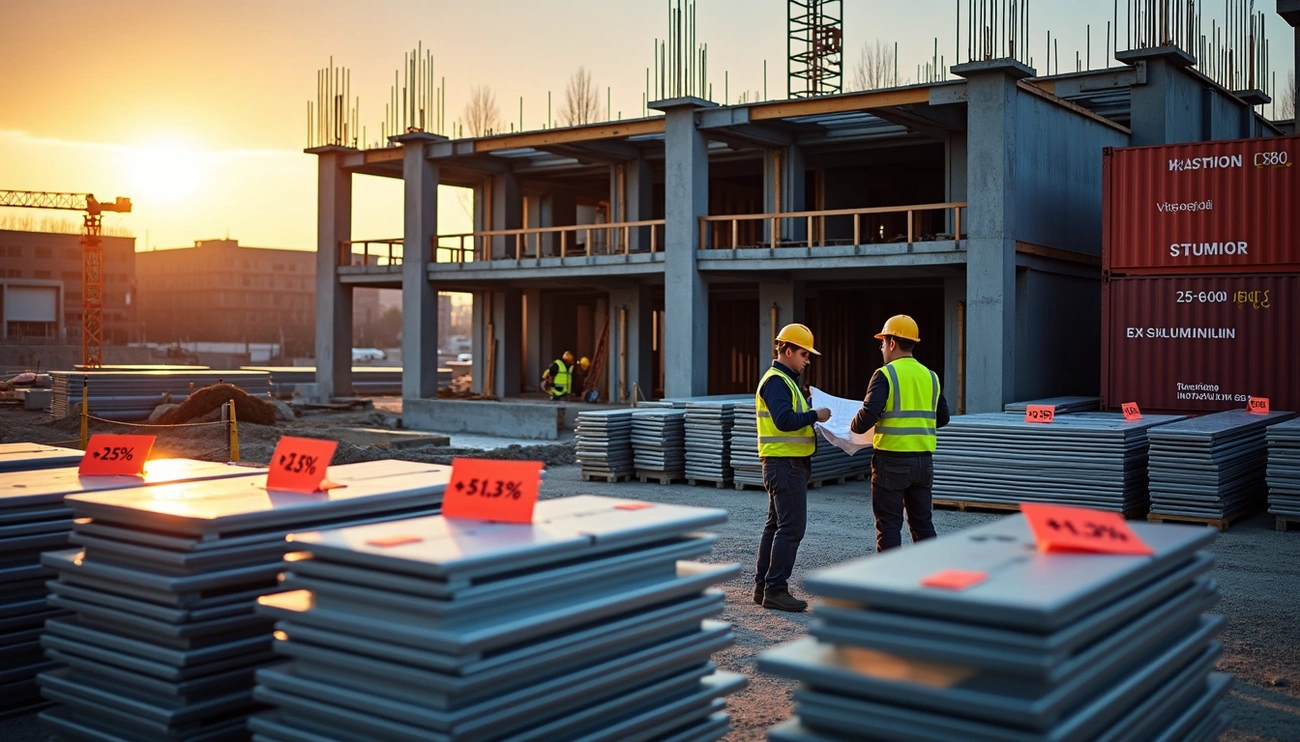
Current trends in construction procurement face unprecedented disruption as metal tariffs reach a 40-year high of 25% to 30% in 2025. The expanded aluminum and steel tariffs, particularly those reaching up to 50%, have dramatically reshaped the construction materials landscape, affecting $320 billion worth of products. Consequently, construction material costs have increased by 9% relative to average materials costs in 2024.
The impact on construction industry trends extends beyond raw materials. Total project costs are estimated to rise 4.6%, while hot roll coil prices have surged from $680 to $950 per ton—almost a 40% increase. Furthermore, the increased cost of construction has led to nearly 25% of contractors delaying or canceling projects due to tariff costs, with data showing an 88.2% year-over-year increase in project abandonment activity for August 2025.
This report examines how aluminum tariffs impact construction across the entire procurement ecosystem, from policy changes to strategic responses. Specifically, it analyzes how steel and aluminum—which together account for 15-30% of a typical U.S. building’s direct material budget—are forcing a fundamental rethinking of aluminum procurement strategies in construction across both private and public sectors.
Key Takeaways
The 2025 US metal tariffs have created unprecedented disruption in construction procurement, with aluminum and steel tariffs reaching 50% and affecting $320 billion worth of products. Here are the critical insights construction professionals need to navigate this challenging landscape:
- Material costs surge 9% in 2025 with total project costs rising 4.6%, driven primarily by aluminum tariffs reaching 50% and steel price increases of 40%
- Lead times extend dramatically to 25-60 weeks for specialty aluminum, forcing contractors to maintain 30-50% higher inventory levels and plan procurement much earlier
- Strategic contract restructuring is essential through material price escalation clauses, indexed pricing, and vendor-managed inventory systems to protect against volatile costs
- Domestic sourcing becomes competitive advantage as BABAA compliance requirements and tariff avoidance create dual benefits for government-funded projects
- Digital procurement platforms enable predictive purchasing using AI-powered analytics to anticipate price trends and optimize inventory management before disruptions occur
The construction industry must fundamentally rethink procurement strategies, moving from reactive purchasing to proactive risk management. Companies that diversify supplier networks, implement flexible material substitution capabilities, and leverage technology for predictive analytics will emerge stronger from this tariff-driven transformation.
Tariff Policy Timeline and Scope (2024–2026)
The U.S. metal tariff landscape underwent dramatic restructuring throughout 2025, creating significant implications for construction procurement strategies. Beginning February 10, 2025, President Trump issued proclamations that fundamentally altered the aluminum and steel import environment.
Section 232 Reinstatement and 50% Aluminum Tariff in 2025
Initially, the February proclamations reinstated the full 25% tariff on steel imports and increased aluminum tariffs from 10% to 25% for all countries, effective March 12, 2025. This action was based on Section 232 of the Trade Expansion Act of 1962, which authorizes import adjustments when national security is potentially threatened. Subsequently, on June 3, 2025, a more aggressive stance emerged with tariffs on both steel and aluminum articles increasing from 25% to 50% ad valorem, effective June 4, 2025. The sole exception remained the United Kingdom, which maintained a 25% tariff rate as negotiations continued on the US-UK Economic Prosperity Deal.
Expansion to 407 HTSUS Subheadings: Fabricated Product Coverage
On August 19, 2025, the Bureau of Industry and Security dramatically expanded the scope of affected products by adding 407 Harmonized Tariff Schedule (HTSUS) codes to the list of steel and aluminum derivative products. This expansion, effective August 18, 2025, captured finished goods across numerous categories, including:
- Consumer goods (perfumes, cosmetic preparations)
- Energy products (liquefied propane)
- Industrial equipment (fork-lift trucks, bulldozers)
- Vehicle parts and components
- Furniture and household items
Notably, these tariffs applied specifically to the steel and aluminum content of products rather than their entire value, creating complex compliance requirements for construction material suppliers.
Termination of Exemptions for Canada, Mexico, and EU
A critical element of the 2025 tariff restructuring was the elimination of previously negotiated country exemptions. The proclamations terminated all alternative agreements and exemptions previously granted to Argentina, Australia, Brazil, Canada, EU countries, Japan, Mexico, South Korea, Ukraine, and the United Kingdom. This represented a substantial shift in U.S. trade policy, as many of these countries had established tariff rate quotas or other arrangements following the original 2018 Section 232 tariffs. Additionally, this termination prompted retaliatory measures, with Canada imposing 25% duties on CAD 29.80 billion worth of U.S. imports, creating further complexity in the construction materials supply chain.
Cost Impact on Construction Projects and Materials
Tariff-induced price escalations across the construction sector are reshaping budget expectations and procurement timelines. According to recent industry analyzes, the compounding effects of these policy changes have created significant financial pressures across all building categories.
9% Increase in Construction Material Costs in 2025
Cushman & Wakefield’s analysis reveals that tariffs on imported building materials are expected to increase construction materials costs by an average of 9% in 2025. Materials cost increases range from 8.5% to 9.6% depending on property type. Metals account for up to two-thirds of these tariff-driven increases, with steel and aluminum bearing the brunt of the impact. Essentially, four major rebar manufacturers raised their prices by USD 60.00/ton in June 2025, causing construction-grade steel’s average per-ton cost to surge more than 20% within the year.
4.6% Rise in Total Project Costs: Case Study Analysis
Total project costs are projected to rise 4.6% in Q4 2025 compared to Q4 2024, assuming no changes to labor and other building costs. In one detailed case study shared by Skanska, the new tariffs could add approximately USD 22.00 million to a USD 375.00 million healthcare development. Nearly half of that jump is tied to derivative components that embed steel or aluminum in their assemblies. Tariff pass-through to end-users is estimated at 75%, meaning most costs will ultimately be absorbed by contractors, developers, and tenants.
Aluminum Pricing Trends: USD 2,300/ton Forecast
Fitch Ratings provides a medium-term aluminum price forecast:
- Average USD 2400.00 per ton in 2025
- Falling to USD 2300.00 for 2026 and 2027
Goldman Sachs predicts prices will rebound to USD 2300.00 per metric ton by December 2025, amid a global aluminum market surplus of 580,000 tons this year. The U.S. Midwest Premium reached a historic high of 60 cents per pound (USD 1,323 per metric ton) as of June 2025—a 190% increase since November 2024.
Impact on Healthcare and Data Center Construction Budgets
Healthcare facilities face particular challenges as medical supply expenses collectively accounted for USD 146.90 billion in 2023. According to VMG Health, a USD 10.00 million healthcare project would cost about USD 573,761.00 (~5.74%) more because of tariffs, with steel driving USD 451,000.00 of that increase. Meanwhile, data centers bear the heaviest burden, as Cushman & Wakefield identifies them as the most heavily impacted sector. Current and proposed tariff policies threaten USD 75.00–100 billion in additional AI infrastructure costs over five years, equivalent to 15–20 fewer hyperscale facilities.
Procurement Strategy Shifts in Response to Tariffs
Construction firms are implementing robust procurement strategies to navigate the evolving tariff landscape. These approaches emphasize supply chain resilience and cost predictability in uncertain markets.
Vendor-Managed Inventory (VMI) for Just-in-Time Fulfillment
As tariffs create inventory cost pressures, construction firms are turning to vendor-managed inventory models where suppliers take responsibility for maintaining optimal material levels at customer locations. This collaborative approach enables real-time inventory tracking through electronic data interchange systems, allowing suppliers to generate replenishment orders based on predetermined thresholds. The global VMI market, valued at USD 3.90 billion in 2023, is projected to reach USD 6.30 billion by 2030. Moreover, VMI implementation reduces stockouts during tariff-induced supply disruptions, especially for critical building materials like steel and aluminum.
Material Substitution and Domestic Sourcing Trends
In response to tariff volatility, contractors are adopting “no-regret” strategies that deliver value regardless of how trade policies evolve. These include strategic stockpiling to buffer against price fluctuations, material substitution with cost-effective alternatives, and increased domestic sourcing to reduce tariff exposure. Additionally, many firms are pursuing vertical integration and supplier diversification to enhance resilience against future trade policy shifts.
Escalation Clauses and Indexed Pricing in Contracts
Construction contracts increasingly incorporate specialized provisions addressing tariff-related price volatility. Material price escalation clauses allow for adjustments when costs exceed predetermined thresholds. Effective clauses typically:
- Identify specific materials subject to price adjustments
- Establish baseline prices and escalation triggers
- Require documentation from suppliers to verify increases
- Outline structured processes for approving adjustments
Many contracts now link pricing directly to external indices such as the Producer Price Index for Construction Materials.
Aluminum Sourcing Strategy for Government Projects (BABAA Compliance)
The Build America, Buy America Act (BABAA) establishes domestic content procurement preferences for federally funded infrastructure projects. Under these requirements, all aluminum used must be produced in the United States, with manufactured products containing at least 65% U.S.-made components. For government contractors, this necessitates working with certified U.S. suppliers providing clear documentation of compliance with “melted and poured” rules. Firms must now lock in long-term agreements with U.S. mills, anticipate longer lead times, and adjust bid pricing to reflect domestic sourcing costs.
Supply Chain Disruptions and Long-Term Risk Management
Supply chain volatility extends far beyond price increases, fundamentally altering how construction firms manage material planning and risk mitigation. These disruptions require comprehensive approaches to ensure project continuity.
Lead Time Expansion: 25–60 Weeks for Specialty Aluminum
Hard alloy extrusion lead times have stretched dramatically to 50-90 weeks, with parts that previously required just 12-14 weeks now demanding 32-36 weeks. This expansion stems from limited supplier capacity, as only four main companies in the U.S. specialize in extruding hard alloys. Consequently, construction timelines face unprecedented uncertainty, particularly for specialized infrastructure projects.
Port Congestion and 200% Tariff on Unknown-Origin Aluminum
Port delays averaging 12-18 days exacerbate logistical challenges, while documentation requirements add 5-7 additional processing days. Unfortunately, effective June 28, 2025, aluminum imports with unknown country of smelt and cast face a punitive 200% Section 232 tariff. This policy forces importers to report “unknown” when origin cannot be verified, triggering the same duty rate assessed on Russian-origin aluminum.
Supplier Allocation Systems and Contingency Buffers
Many mills have implemented allocation systems, unable to fulfill all customer orders. Indeed, successful firms now maintain 30-50% higher inventory levels and refill at 60% of need rather than previous 40% thresholds.
Digital Procurement Platforms for Predictive Purchasing
AI-powered analytics increasingly enable construction firms to deploy predictive models for risk assessment. Don’t let tariffs derail your next project. Connect with ADM to explore U.S.-based aluminum solutions designed to stabilize costs and strengthen your supply chain. Smart inventory systems monitor real-time stock levels, triggering automatic reorders when supplies run low.
Conclusion
Aluminum and steel tariffs have fundamentally reshaped the construction procurement landscape, creating ripple effects throughout the entire building sector. Market data undoubtedly confirms these policy shifts have driven material costs 9% higher while pushing total project expenses up 4.6% year-over-year. Construction executives consequently face unprecedented challenges balancing budget constraints against project delivery expectations.
Strategic adaptation remains essential for organizational survival amid this tariff-driven volatility. Firms that implement vendor-managed inventory systems generally experience fewer disruptions compared to those relying on traditional procurement methods. Additionally, contract structures now require careful consideration, particularly through implementation of material price escalation clauses that provide essential protection against sudden cost fluctuations.
Supply chain resilience has emerged as a competitive differentiator rather than merely an operational concern. The extended lead times for specialty aluminum—stretching between 25 and 60 weeks—necessitate earlier procurement planning and robust contingency strategies. Furthermore, domestic sourcing initiatives offer dual benefits of tariff avoidance and BABAA compliance for government-funded projects.
Risk management approaches must therefore evolve accordingly. Forward-thinking construction leaders now utilize predictive analytics and digital procurement platforms to anticipate pricing trends before they materialize. These technological solutions, coupled with strategic supplier partnerships, create essential buffers against market volatility while maintaining project viability.
The current tariff environment, though challenging, presents opportunities for construction executives to reassess procurement fundamentals. Companies that diversify supplier networks, establish transparent pricing mechanisms, and maintain flexible material substitution capabilities will likely weather this disruption most effectively. Essentially, this period of adjustment requires construction leaders to balance short-term cost pressures against long-term strategic positioning in an increasingly complex materials marketplace.
Don’t let cost increases derail your next project. Connect with ADM to explore U.S.-based aluminum solutions designed to stabilize costs and strengthen your supply chain.
FAQs
Q1. How have the recent US metal tariffs affected construction costs?
The 2025 US metal tariffs have led to a 9% increase in construction material costs and a 4.6% rise in total project costs. Steel and aluminum tariffs, reaching up to 50%, have significantly impacted the construction industry, affecting $320 billion worth of products.
Q2. What strategies are construction firms using to manage tariff-related challenges?
Construction firms are implementing vendor-managed inventory systems, exploring material substitution options, increasing domestic sourcing, and incorporating escalation clauses in contracts. They’re also using digital procurement platforms with predictive analytics to better manage supply chain risks.
Q3. How have lead times for construction materials been affected by the tariffs?
Lead times for specialty aluminum have extended dramatically, now ranging from 25 to 60 weeks. This has forced contractors to maintain 30-50% higher inventory levels and plan procurement much earlier in the project timeline.
Q4. What impact have the tariffs had on government-funded construction projects?
Government-funded projects must now comply with the Build America, Buy America Act (BABAA), which requires all aluminum used to be produced in the United States. This has led to increased focus on domestic sourcing and the need for clear documentation of material origin.
Q5. How are construction firms mitigating risks associated with the new tariffs?
Firms are diversifying supplier networks, establishing transparent pricing mechanisms, and maintaining flexible material substitution capabilities. They’re also using AI-powered analytics and digital procurement platforms to anticipate pricing trends and optimize inventory management.