
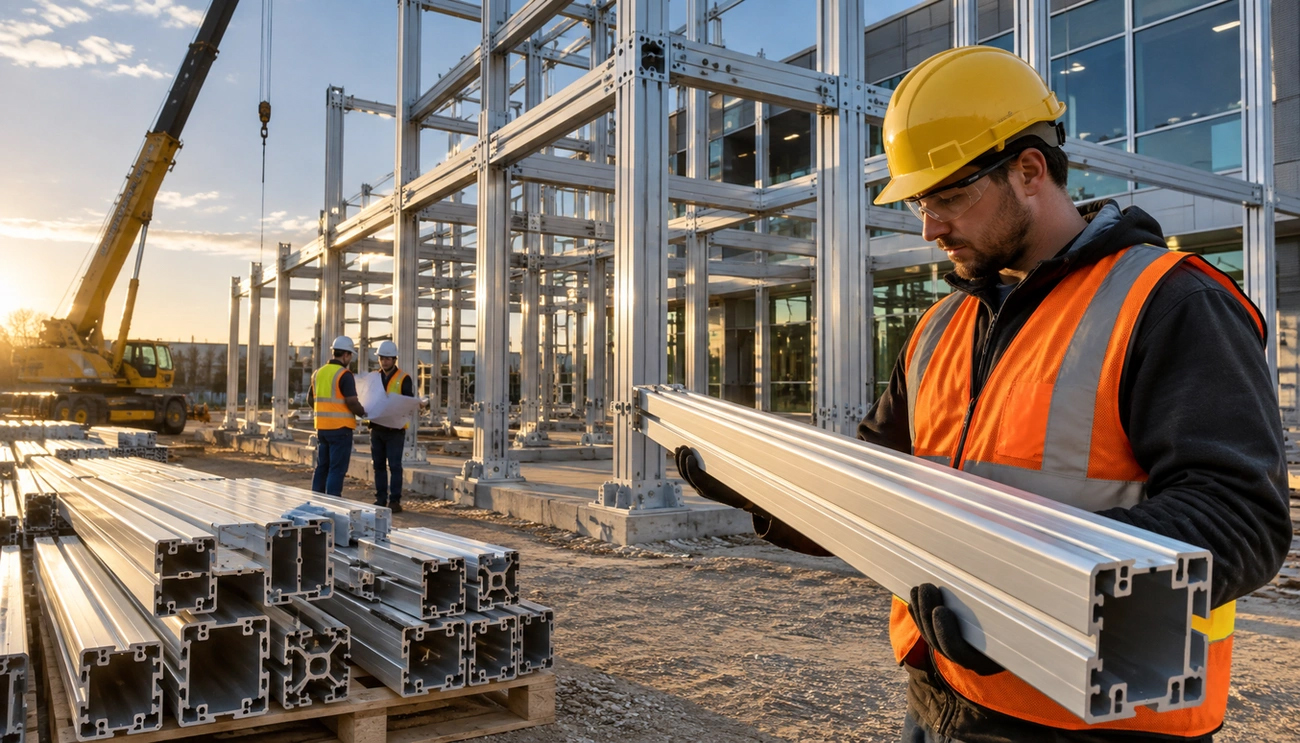
Construction accounts for about 35% of all aluminum extrusion use in North America, which means that extruded structural aluminum is a vital component in today’s building projects. The fact that it is so widely used is due to the ability of the extrusion process to produce custom cross-sections that are tailored to particular functional and structural needs. Architects, engineers, contractors, and procurement managers depend on aluminum extrusion systems because of their excellent strength-to-weight ratio and design flexibility.
Even so, when specifying extruded aluminum structural framing, it is necessary to consider the choice of alloy, the tolerances associated with aluminum extrusion, and the design of the connections, with these aspects having to be verified by engineering.
This guide explains how aluminum extrusion is produced, the advantages of using structural aluminum profiles in construction, the specification requirements such as those relating to aluminum extrusion finishes for buildings, and how to source custom structural aluminum extrusions to meet a range of project requirements.
Key Takeaways
- Aluminum provides a better strength-to-weight ratio since it is 65% lighter than steel and still has a strength-to-weight ratio of 2.8:1, which in turn reduces foundation loads and transportation costs.
- The alloys in the 6000 series are mainly used in construction work – 6063 being suitable for architectural purposes because of its good surface finish and 6061 being appropriate for structural applications since it has a higher strength (290 MPa tensile).
- By using custom extrusions, it is possible to optimise the way material is distributed, so that engineers can design cross-sections specifically for each project, combining several components together, cutting down on the time needed for assembly, and accurately matching the load requirements.
- The need for maintenance is eliminated since the oxide layer that forms on aluminium itself gives it a service life of up to 70 years without the necessity of painting, recoating, or having to spend money on rust treatment.
- Getting the specification right demands a high degree of engineering precision, which involves carrying out accurate load calculations with safety factors of 4 to 5, selecting tolerances that are appropriate according to ANSI H35.2, and working early on with the manufacturer to review the feasibility.
What is Extruded Structural Aluminum and How is It Made
The Aluminum Extrusion Process Explained
To create an aluminium extrusion, solid billets are turned into accurately engineered structural profiles as the heated metal is forced through a shaped steel die. A cylindrical aluminium billet is preheated in a furnace to a temperature ranging from 400 to 500 degrees Celsius, which makes the metal malleable without it reaching its melting point of about 660 degrees Celsius. The extrusion die, made from H13 tool steel, is also preheated to a temperature between 450 and 500 degrees Celsius in order to maximise die life and to ensure even flow of the metal.
A release agent is used to prevent the material from sticking. A hydraulic ram then pushes the softened billet into the press container with great pressure, the pressure often reaching as much as 15,000 tons. As the pressure increases, the aluminium expands and fills the sides of the container. It is forced through the opening in the die and comes out as a complete profile that has the same cross-sectional shape as the die. A puller holds the hot extrusion and guides it along a runout table. The extrusion is cooled down by means of water baths or fans in order to control its mechanical properties.
When the material has reached the full length of the table, a hot saw cuts it to the required profile. The profile then cools down to room temperature on a cooling table and is subsequently fed into a stretcher. The stretcher clamps onto both ends and pulls the extrusion straight in order to correct any natural twisting and bring it up to specification. At this point the profile has the T4 temper properties. It is possible to age the material in ageing ovens to achieve T5 or T6 tempers. This greatly increases the strength and hardness of the material through controlled heat treatment cycles.
Solid, Hollow, and Semi-Hollow Structural Profiles
Extraordinary shapes can be divided into three categories according to the geometry of their cross-section. Solid profiles have no enclosed cavities and examples of these are beams, rods and angles. Hollow profiles have one or more voids in any part of the cross-section, for instance square or rectangular tubes. Semi-hollow profiles have voids which are only partly enclosed with a narrow gap, for example C-channels. The more complex a shape is, the greater difficulty and cost it presents in terms of extrusion. Solid shapes are easier and less expensive to extrude than semi-hollow ones, since the latter require more accurate die engineering.
Common Aluminum Extrusion Alloys for Construction
The 6000 series is by far the most widely used in structural applications and makes up about 75% of all extrusion usage. Alloy 6063, which is generally referred to as architectural aluminium, has very good extrudability and a surface finish that is suitable for anodizing; in T5 temper it has a tensile strength of 190 MPa and a yield strength of 160 MPa. Alloy 6061, known as structural aluminium, has outstanding mechanical properties, with a tensile strength of 290 MPa and a yield strength of 240 MPa when in T6 temper. Both alloys have magnesium and silicon as their main alloying elements, although 6061 contains more copper, chromium and iron.
An explanation of the differences between T-Slot and custom structural profiles
The T-slot aluminium extrusion has T-shaped channels which are precision-engineered along the entire length of the profile, enabling a modular assembly without the need for welding. Standardised profiles are available in fractional series (10, 15) and metric series (30, 40, 45 mm), with specific slot widths to take up compatible fasteners and brackets. Custom structural aluminium extrusions require a special die design and tooling. Such dies produce cross-sections that are tailored to the particular load paths, connection requirements and integration needs of a project. T-slot systems allow for rapid reconfiguration, whereas custom profiles are designed to optimise the distribution of material to meet specific structural demands and fabrication procedures.
Key Benefits of Extruded Aluminum Structural Framing in Construction
Superior Strength-to-Weight Ratio
Aluminum has a weight that is approximately one-third that of steel and provides a strength-to-weight ratio of 2.8:1 as compared to steel. This advantage in terms of density means that structural aluminum profiles used in construction can weigh as much as 65% less than equivalent steel sections. The reduced mass makes handling easier and lowers the demands on the foundation. Transportation costs are also reduced. In projects located in cold climates the strength of aluminum increases as the temperature falls.
Corrosion Resistance and Weather Durability
Aluminium that has been extruded resists corrosion due to a natural oxide layer which guards the metal without the need for extra coatings. This kind of built-in protection removes the need to worry about rust and can result in a service life of up to 70 years. In contrast, steel structures must be coated with paint or galvanised, since these coatings are prone to chipping and demand frequent maintenance. When aesthetic or environmental conditions justify it, the finish of aluminium extrusions used in buildings can be improved for corrosion resistance by means of anodising or powder coating.
Design Flexibility and Customization Options
By using the extrusion method it is possible to produce one-piece profiles with complex cross-sections without having to join them mechanically. Aluminum extrusions that are tailored to specific applications can have different wall thicknesses and include internal reinforcement in those areas where structural analysis shows that strength is concentrated. The ability to design in this way enables engineers to optimize the way material is distributed for particular load paths while at the same time keeping connection compatibility and fabrication efficiency.
Affordable Solutions Compared to Steel and Other Materials
Although aluminium has higher material costs on a per-pound basis, its resistance to corrosion removes the need for continuous repainting and rust treatment. Its light weight also reduces the amount of labour required for installation and the need for special equipment. Furthermore, since aluminium extrusion allows for tight tolerances and the die tools are inexpensive, it is economically feasible to produce custom profiles even with only moderate production runs.
Environmental Sustainability and Recyclability
Almost 75 per cent of all the aluminium that has ever been produced is still in use and shows outstanding durability. The energy required to recycle aluminium is only 5 per cent of that needed for its primary production. Aluminium profiles which have been extruded retain all their structural properties even after an infinite number of recycling cycles without any deterioration. These features align with the principles of a circular economy and help to reduce the carbon footprints of projects.
Specifying Aluminum Extrusion Systems for Your Construction Project
Determining Load Requirements and Structural Needs
The correct way to proceed is to calculate the bending stress, deformation, and deflection in view of the method of fixation. The area moment of inertia is a measure of a beam’s resistance to bending. The torsional constant is a measure of the resistance to twisting about the axis. In construction applications safety factors between 4 and 5 are needed, and higher values must be used where there is a risk of injury. When working out the section properties that are required, designers have to take into account the dead loads, the live loads, the wind loads and the snow loads.
Selecting Appropriate Aluminum Extrusion Tolerances
Standard dimensional tolerances are given in ANSI H35.2 and in publications by the Aluminum Association that deal with twist, straightness, flatness, and angularity. Tolerances should only be made more tight for dimensions which fit with other components. Increasing the precision of the tooling and carrying out additional inspection raises the costs without improving the surfaces of any parts that are not in contact with anything. For metal dimensions, the rule applies when 75 per cent or more of the dimension consists of solid material, whereas for space dimensions the rule applies when more than 25 per cent is void.
Choosing the Right Aluminum Extrusion Finishes for Buildings
Anodizing produces a durable oxide layer that has excellent resistance to corrosion and abrasion, and its appearance can last for many decades. Powder coating provides greater aesthetic versatility in terms of available colours and textures and also has good resistance to both impacts and chemicals. According to AAMA 2604, the performance after five years of exposure in Florida is specified, and AAMA 2605 demands a durability over ten years.
Aluminium extrusions of a custom structural type as opposed to standard profiles
It is appropriate to use custom tooling in cases where no standard section has the required geometry, when it is necessary to combine several components into a single cross-section, or when weight and stiffness are the factors that determine performance requirements. Although standard profiles have the advantage of lower initial costs and shorter lead times for smaller production volumes, custom extrusions provide value by reducing assembly time, getting rid of the need for separate components, and simplifying the fabrication process at higher volumes.
Essential Accessories and Connection Hardware
To achieve a secure assembly without the need for welding, T-slot systems require compatible T-nuts, square nuts, corner brackets, and pivot joints. The accessories available are lift-off hinges, door catches, handles, panel mount brackets, leveling feet, and roller wheels for use in sliding applications. The connection components have to correspond to the profile series dimensions, and most of the hardware is suitable for 10, 15, 20, 30, 40, and 45 series profiles.
How to Source and Purchase Extruded Aluminum Structural Profiles
Working with Extrusion Manufacturers and Suppliers
Giving a full request for a quote speeds up the pricing and feasibility assessment. Include CAD models together with dimensioned cross-section drawings, specify the alloy and temper, state the critical dimensions together with their tolerances, give the cut lengths and quantities, state the surface finish requirements, list any further machining needed and include the inspection requirements. It is important to differentiate between the number of items required for prototyping and those needed for production. The manufacturers evaluate the cost of tooling against the expected order cycles.
The choice between pre-cut and full-length material.
Profiles that have been cut to length and which have holes, tapped ends, or other required modifications carried out before they are shipped remove the need for internal processing costs. Full-length extrusions of up to 4 metres are sent by LTL truck. Cut-to-size pieces that match standard parcel dimensions are dispatched by ground courier and are delivered more quickly at a lower freight charge. For large orders, the difference in freight cost is significant.
Lead Times and Production Schedules
The lead time for simple solid extrusions is 2 to 3 weeks, that for tube dies is 3 to 4 weeks and standard profiles are dispatched within 7 days. Complex geometries take 10 to 15 days provided that no die modifications are required. Each fabrication process adds 1 to 2 weeks to the lead time and the actual extrusion production takes 48 hours from the moment the material exits the press until artificial ageing is completed.
Quality Assurance and Testing Standards
Dimensional inspection is carried out using calipers, micrometers, optical comparators, and coordinate measuring machines to achieve an accuracy level of a micron. The material certificates give details of the actual chemical composition, the production specifications, and the lot numbers which can be traced back to the raw billet production.
Conclusion
Aluminium extrusions offer outstanding flexibility when it comes to the design of building projects and enables sections to be designed according to particular performance needs. Even so, this versatility still requires the correct choice of alloy and precise specification of tolerances. It is essential to design the connections properly and to carry out thorough structural verification. When specifying aluminium extrusion systems, it is important to balance the material’s natural advantages against careful consideration of the limitations involved in fabrication and of the relevant engineering principles. The success of a project can be improved by working early on with experienced extrusion manufacturers, since these professionals are familiar with both the design possibilities and the practical limitations.
FAQs
Q1. What is the difference between solid, hollow, and semi-hollow aluminium extrusions?
Solid profiles have no enclosed voids and consist of shapes such as beams, rods and angles. Hollow profiles enclose one or more voids at any point in the cross-section, for example square or rectangular tubes. Semi-hollow profiles have partially enclosed voids with a narrow gap, for instance C-channels. Solid shapes are the simplest and most cost-efficient to extrude, whereas semi-hollow ones need more accurate die engineering and are more expensive.
Q2. What aluminum alloys are most frequently used in structural construction?
The alloys in the 6000 series are most used in such applications, making up about 75% of all extrusion use. Alloy 6063, which is referred to as architectural aluminium, has a very good surface finish and is therefore suitable for anodizing. Alloy 6061, known as structural aluminium, has better mechanical properties and higher strength ratings. Both of these alloys have magnesium and silicon as their main alloying elements, although alloy 6061 also contains extra copper, chromium, and iron to improve its strength.
Q3. What is the strength-to-weight ratio of aluminium compared to that of steel when it comes to construction?
Aluminium weighs about one-third that of steel and has a strength-to-weight ratio of 2.8:1 as against steel. Structural aluminium profiles can be up to 65% lighter than equivalent steel sections, which makes handling easier, reduces the need for a strong foundation, and lowers transportation costs. Moreover, the strength of aluminium increases as the temperature decreases, which makes it especially beneficial for projects in cold climates.
Q4. What are the typical lead times for ordering custom aluminum extrusions?
Tooling lead time for simple solid extrusions requires 2-3 weeks, while tube dies need 3-4 weeks. Standard profiles typically ship in 7 days, while complex geometries take 10-15 days when no die modifications are needed. Each additional fabrication process adds 1-2 weeks to the lead time. The actual extrusion production itself takes approximately 48 hours from press exit through artificial aging.
Q5. Why is aluminum considered environmentally sustainable for construction?
Nearly 75% of all aluminum ever produced remains in use today, demonstrating exceptional material longevity. Recycling aluminum requires only 5% of the energy needed for primary production, and the material maintains full structural properties through infinite recycling cycles without degradation. These characteristics support circular economy principles while significantly reducing project carbon footprints compared to other construction materials.